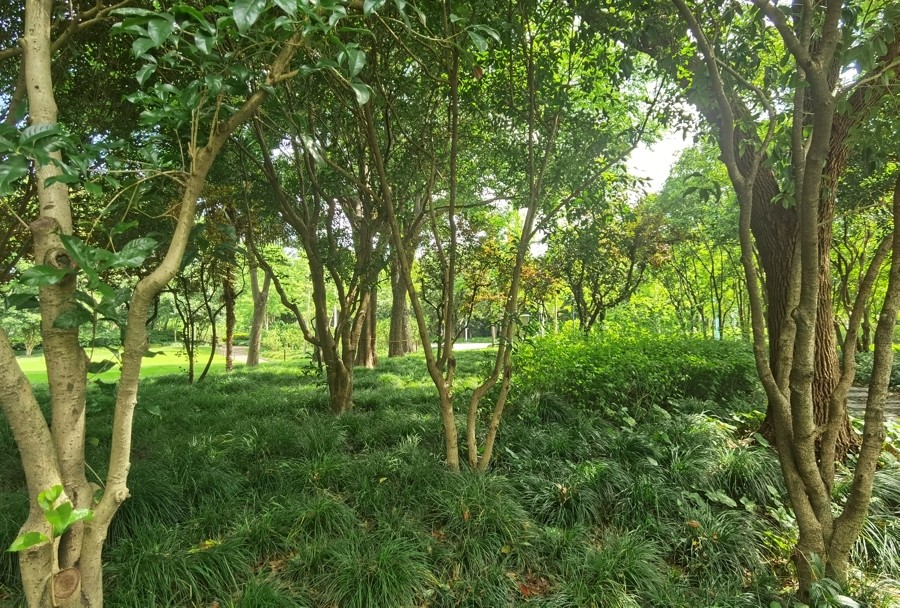
Researchers can now calculate carbon storage for every single urban tree without cutting it down, turning vague carbon estimates into targeted carbon regulation for city greenbelts.
A technology project was awarded second prize at the 2025 Shanghai Science and Technology Awards. The breakthrough sets a national benchmark for low-carbon landscaping and park city development in Shanghai.
After 20 years of joint research, the team led by professor Qin Jun, chief engineer at Shanghai Chenshan Botanical Garden, solved three major bottlenecks including unreliable carbon measurement, low carbon efficiency and coarse decision-making for urban green carbon sinks. It built a full technical chain covering carbon measurement, carbon enhancement and smart management.
Traditional forest carbon assessment relies on destructive sampling. Workers cut tree trunks into segments every one or two meters, weigh samples before and after drying, and calculate carbon sequestration from the weight difference. The method is labor-intensive, damages trees and covers only a limited number of varieties, said Zhang Qingfei, senior engineer at Chenshan Botanical Garden.
The team developed a single-tree productivity correction factor model and launched a non-destructive rapid carbon calculation method suited for highly varied urban environments. The new method reaches more than 95 percent of the accuracy of the felling test without harming trees.
On this basis, the team has built a regional database covering 215 high-carbon tree varieties and an online inquiry system for the Yangtze River Delta. The ecological carbon value of each plant can now be quantified and compared numerically.
Researchers identified native high-carbon species including camphor, hackberry, Chinese tallow, zelkova and dawn redwood. These varieties require little maintenance, sustain long-term carbon storage and support biodiversity. Their carbon sequestration capacity is more than 30 percent higher than ordinary trees, guiding planting plans for roadside trees, urban parks and residential greenbelts.
For a tree with a 20-centimeter trunk diameter, the average carbon stock hits 82.4 kilograms for Chinese soapberries, 75.6 kilograms for zelkova and 72.5 kilograms for plane trees. These trees rank among Shanghai's top carbon absorbers.
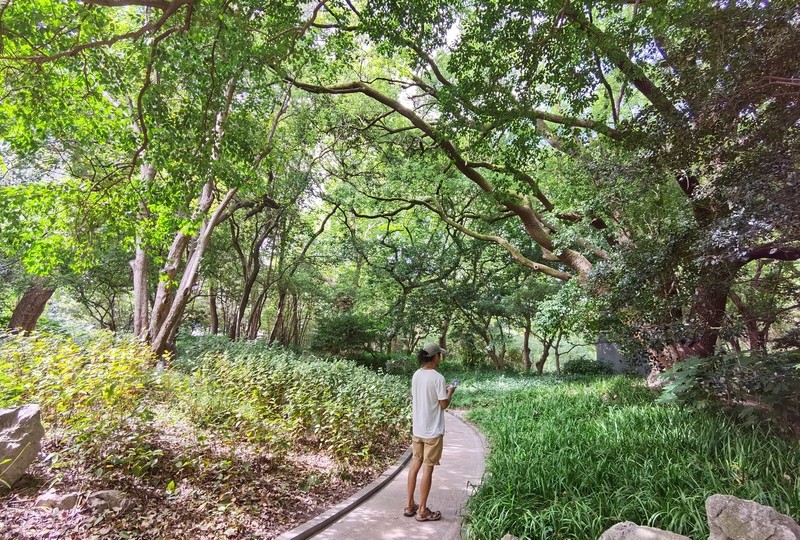
Some underused deep-rooted varieties such as Chinese pistache and Chinese bishopwood, previously struggled with Shanghai's high groundwater levels. By raising terrain to prevent waterlogging, these trees now thrive. Both rank among the top 30 carbon-storing species, with Chinese pistache leading the list of comprehensive ecological functions. They will be widely planted across Shanghai.
Beyond single-tree measurement, the technology optimizes mixed plant communities to raise collective carbon sinks. A demonstration forest at West Bund Art Park mixes tall trees including golden rain tree and camphor with shrubs and ground cover across more than 20 varieties.
Field tests show mixed-species stands store roughly 20 percent more carbon than pure camphor forests of the same area. Irrigation frequency dropped from four times a week to once or twice, lowering emissions from water and power use. On-site recycling of garden waste further cuts carbon output.
The team monitored carbon dynamics across 65 typical green communities for 20 years to track long-term carbon trends. It built evaluation models for carbon potential and developed integrated plans combining pruning, soil improvement and water-saving irrigation. Pilots in Hongqiao Central Business District, Chenshan Botanical Garden and West Bund Art Park lifted carbon sequestration by 28.9 percent and cut management emissions by 65.1 percent. Static city landscapes have turned into dynamic carbon pumps.
The group also created automatic species identification tools and remote sensing systems to map green space carbon. The intelligent simulation platform enables precise carbon regulation, ending rough manual estimation.
The technology will guide Shanghai's park city projects, including pocket parks, forest belts and new town green rings. Planners can pick climate-adaptive high-carbon species and restructure plant communities to make urban green spaces more carbon-efficient while keeping scenic value. Real-time monitoring supports full-lifecycle refined management for smart park platforms.
The innovation has been applied in Hongqiao CBD, Shanghai's first three-star national green low-carbon district, and eco-communities on the West Bank. Up to 164 landscaping projects across 45 major cities including Beijing and Chengdu have adopted the technical framework.