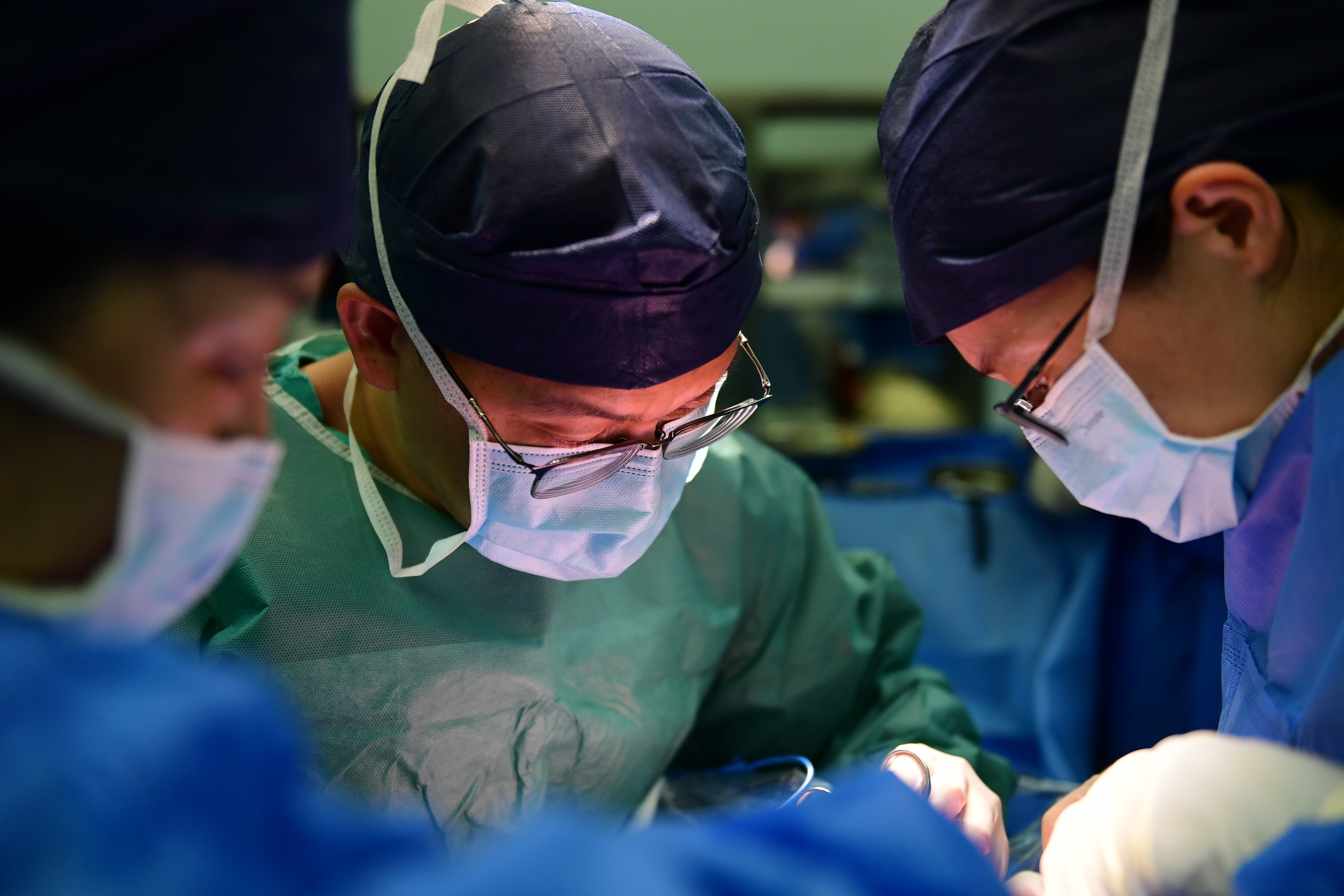
A multidisciplinary surgical team at Fudan University Shanghai Cancer Center has successfully delivered an innovative minimally invasive procedure for tongue base cancer, enabling complete tumor resection while fully preserving the patient's facial contour, mandibular integrity, swallowing capacity, and speech function.
This groundbreaking technique eliminates the facial disfigurement and functional deficits commonly caused by conventional open surgery for deep-seated tongue base malignancies.
Traditional radical resection of tongue base tumors necessitates lip splitting and partial jawbone removal to expose hidden lesions. While oncologically effective, the conventional approach often leaves permanent facial scarring, compromises mandibular stability, heightens the risk of post-radiation bony complications, and causes irreversible swallowing and speech impairment. Which greatly influences patients' long-term quality of life and psychological well-being.
Faced with the prospect of disfiguring conventional surgery, a 53-year-old patient with tongue base cancer sought specialized care at Fudan University Shanghai Cancer Center, pursuing curative oncological treatment without sacrificing facial aesthetics or physiological function.
The hospital's head and neck oncology team conducted a rigorous preoperative workup, including precise three-dimensional tumor mapping and detailed neurovascular risk evaluation. Considering the tumor's invasive biology and high recurrence tendency, the team engineered a customized surgical strategy to achieve complete tumor eradication with minimal structural trauma.
Surgeons adopted an optimized combined intraoral and transcervical minimally invasive approach, replacing the classic mandible-splitting technique. The 6-hour operation established dual surgical corridors, providing unobstructed visualization of the deeply located tumor while safeguarding all critical neurovascular structures.
To repair extensive soft-tissue defects and restore native function, the team performed microsurgical reconstruction using an anterolateral thigh free flap. Ultra-precise microvascular anastomosis re-established robust blood perfusion, accurately reconstructing the tongue base anatomy and allowing functional restoration in a single-stage procedure without secondary surgery.
At the latest follow-up on July 6, the patient showed no facial scarring or maxillofacial deformity. Supported by standardized postoperative rehabilitation, her swallowing and speech functions have recovered significantly, paving the way for a full return to daily life.
"Modern head and neck oncology prioritizes a balanced paradigm combining radical tumor control and optimal patient quality of life," said Dr Ji Qinghai, leader of the head and neck oncology team. "Surgical innovation aims to reduce cosmetic trauma and functional morbidity, allowing patients to achieve durable cancer remission while preserving physical integrity and social confidence."
Ji noted that the center's integrated protocol of minimally invasive resection plus one-stage microsurgical reconstruction sets an elevated clinical benchmark for advanced tongue base cancer management, delivering superior functional and aesthetic outcomes for complex head and neck malignancy patients.
Visit the neck and head comprehensive treatment department of Fudan University Shanghai Cancer Center.
Xuhui Branch 徐汇院区
Address: 270 Dong'an Rd (Xuhui branch) 徐汇区东安路270号
Pudong Branch 浦东院区
4333 Kangxin Rd (Pudong branch) 浦东新区康新公路4333号