A landmark multicenter clinical trial led by professors Peng Junjie and Ding Chunming from Fudan University Shanghai Cancer Center has established an innovative follow-up method for postoperative colorectal cancer patients. The promising research has been officially published in the Journal of Clinical Oncology.
Colorectal cancer features a high risk of postoperative relapse and metastasis. The first two years after surgery are the high-risk period for recurrence. Most metastatic lesions spread to the liver and lungs, accounting for 60% to 70% of all distant metastases.
For decades, routine CT scans have been the standard way to monitor cancer recurrence. However, imaging can only detect tumors after they have grown into visible lesions. By the time abnormalities show up on scans, many patients have already missed the optimal window for curative treatment.
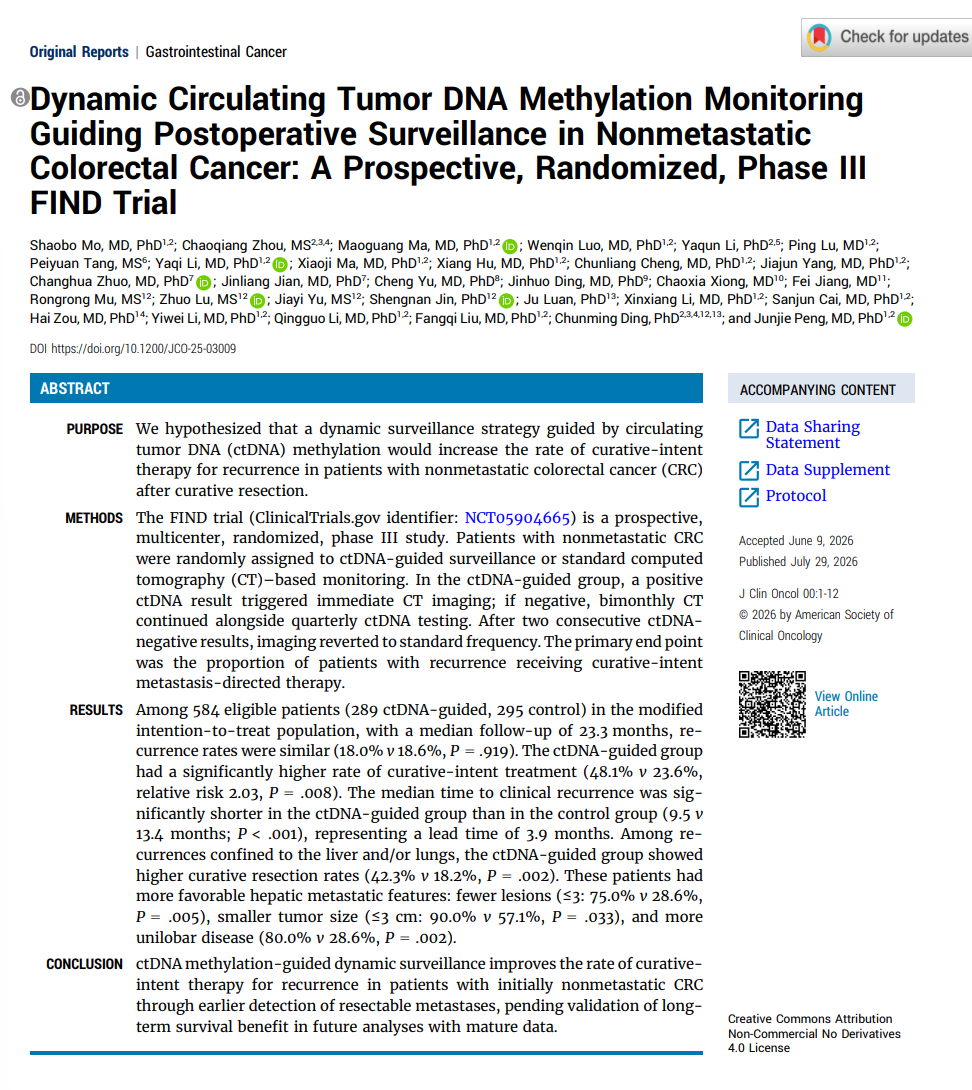
To solve this clinical dilemma, the research team enrolled 584 stage I–III colorectal cancer patients who had undergone radical surgery. The participants were randomly divided into two groups: a new monitoring group using ctDNA methylation liquid biopsy, and a control group receiving traditional CT follow-up.
The ctDNA technology works as a precise blood test. It identifies tiny tumor-derived methylation biomarkers circulating in the bloodstream, long before tumors become visible on scans. Once an abnormal signal is captured, doctors arrange timely enhanced imaging examinations. This method successfully spots recurrence at the early oligometastatic stage, when curative interventions such as secondary surgery and local ablation are still effective.
Two-year clinical data shows remarkable improvements. For patients who experienced recurrence, 48.1% in the ctDNA group received curative treatment, nearly double the 23.6% rate of the conventional CT group.
The ctDNA monitoring detected cancer relapse at a median of 9.5 months after surgery, around four months earlier than standard imaging tests. The blood test reached a recurrence detection sensitivity of 84.1%, significantly outperforming the traditional tumor marker CEA.
This advantage is particularly prominent for liver metastasis — the most common recurrence pattern of colorectal cancer. Lesions detected through ctDNA screening are usually smaller, fewer in number, and confined to a single liver lobe, greatly increasing the chance of complete surgical resection.
Unlike previous overseas studies that simply adjusted chemotherapy intensity based on biomarker results, this Chinese research builds a brand-new surveillance model. Instead of overtreating patients blindly, it focuses on early discovery and curable intervention, precisely locking in treatable early recurrent lesions.
“High-sensitivity ctDNA methylation monitoring transforms postoperative follow-up from passive imaging observation into proactive biological early warning,” said Professor Peng Junjie. Although long-term survival data requires continued follow-up, current results have fully proven the reliability and clinical value of this precision management strategy.
The research team believes ctDNA methylation testing will soon become a standard part of postoperative management for colorectal cancer. It creates a dual-track monitoring system combining blood biomarker early warning and imaging confirmation. This Fudan-developed standardized protocol is set to optimize individualized follow-up and deliver better survival outcomes for colorectal cancer patients worldwide.