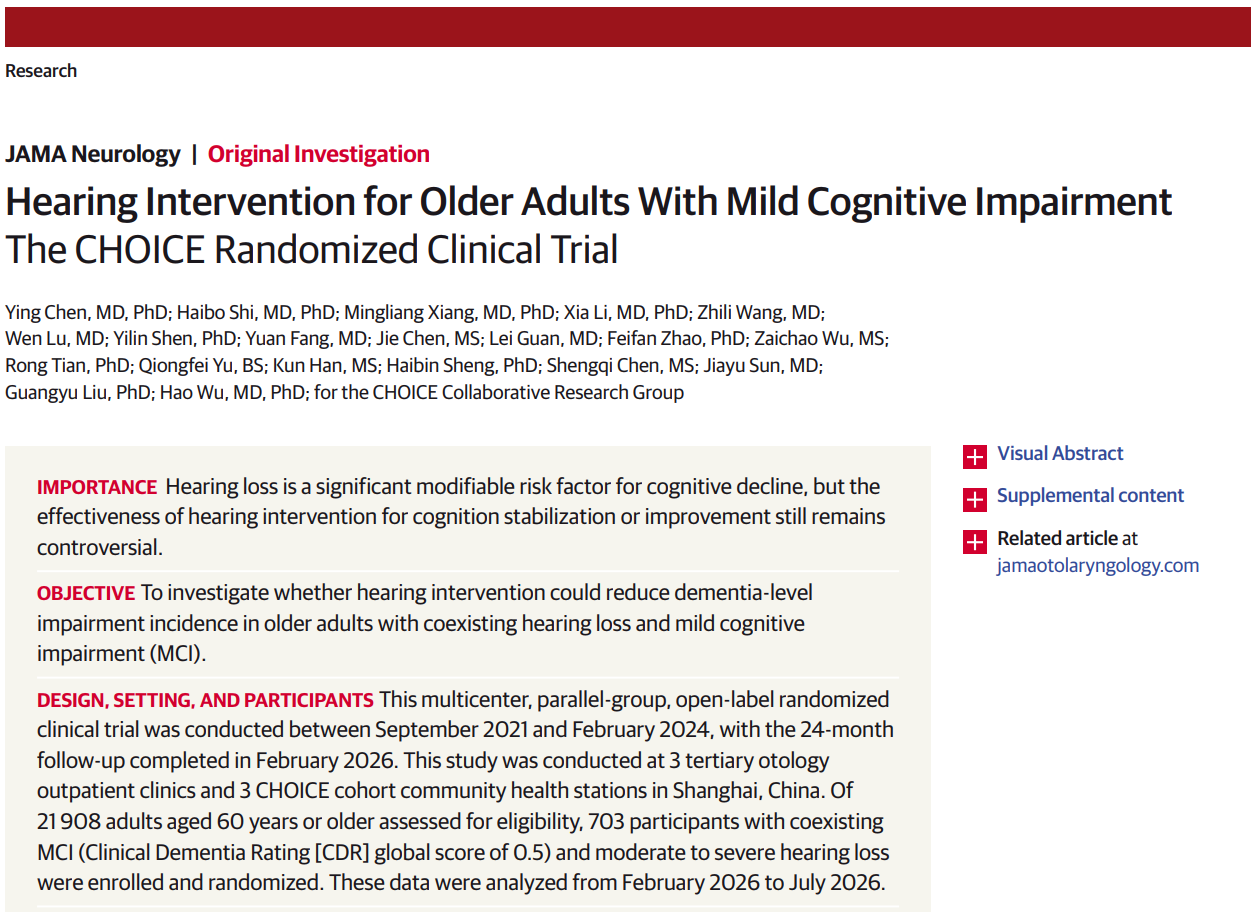
The China Older Adults Hearing and Cognitive Health (CHOICE) study shows that among older adults living with moderate-to-severe hearing loss and mild cognitive impairment (MCI), 15.34% of participants fitted with appropriately prescribed hearing aids regained normal cognitive function within two years — nearly six times the 2.36% observed in the control group who did not use hearing aids. This randomized controlled trial was led by Professor Wu Hao’s research team at Shanghai Ninth People’s Hospital.
The findings were published online in JAMA Neurology on September 28.
The association between hearing status and brain health has become a cutting-edge research area across global brain science, audiology, geriatrics and neuroscience. A Lancet commission report on dementia prevention has consistently identified hearing loss as the top modifiable risk factor for dementia. WHO data indicates the prevalence of disabling hearing loss rises rapidly with age among people aged 60 and above, hitting 58% by age 90.
Even so, hearing aid adoption among older adults in China remains very low. Leveraging community-based senior health screening networks, the CHOICE project screened over 35,000 older adults in Shanghai, Jiangsu and Hainan. It found roughly 77% of Chinese adults aged 60 and above have hearing problems, and nearly 30% suffer from moderate or greater disabling hearing loss. Only 3.5% of this group use hearing aids, while the cochlear implantation rate for profound deafness is a mere 0.47%.
Conducted from 2020 to 2024, the trial recruited 703 participants aged 60 years or older with moderate-to-severe hearing loss and mild cognitive impairment from community health sites and ENT clinics. Their mean baseline age stood at 74.5 years.
Participants were randomly allocated into two groups. The intervention group received professional hearing aid fitting and training on device use, while the control group only obtained education on auditory health and lifestyle without hearing aids. Primary and secondary outcomes included dementia incidence, cognitive reversal rate, hearing function, depressive symptoms and quality of life.
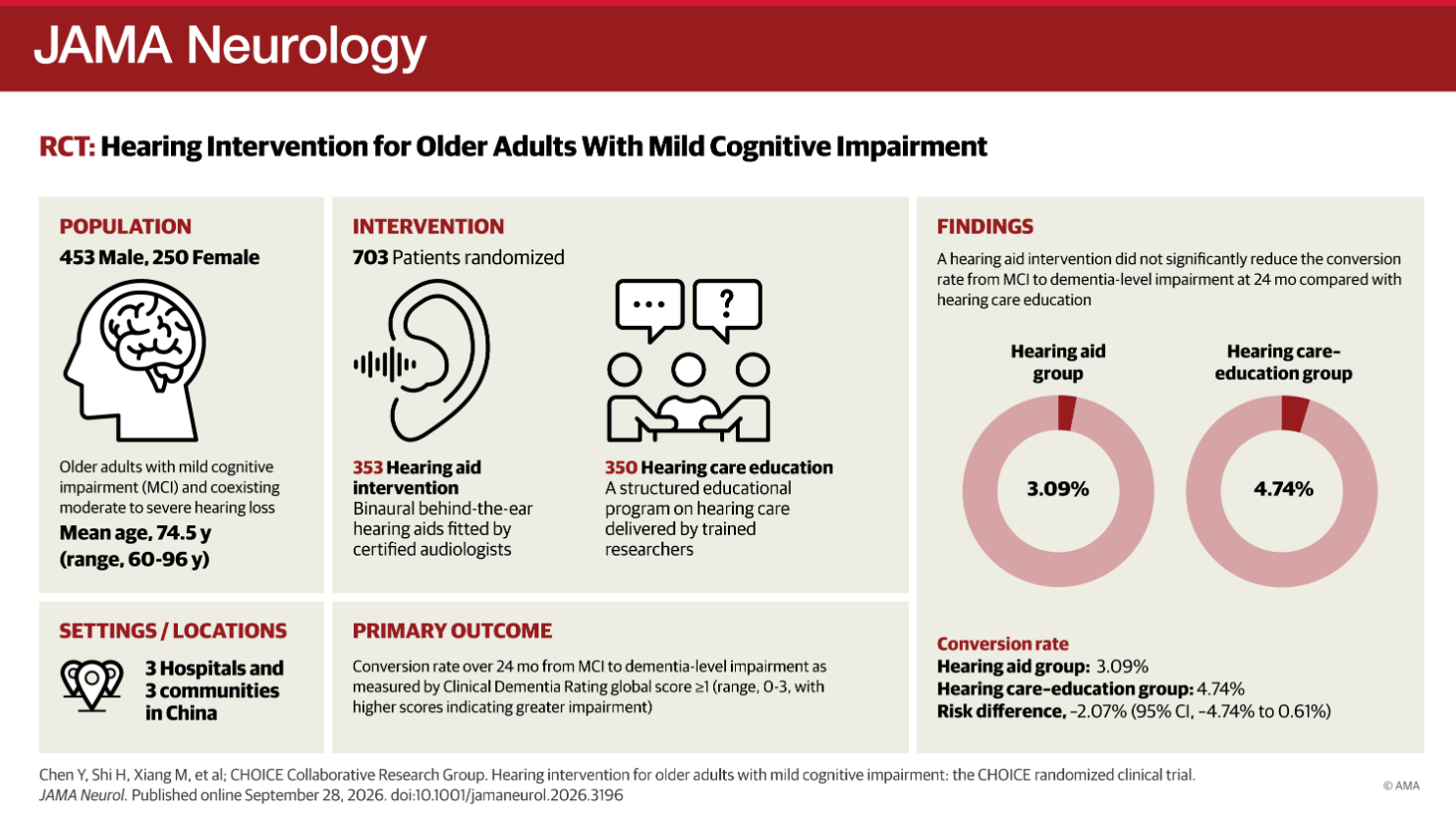
Two-year follow-up data revealed 15.34% of participants in the intervention group reverted to normal cognitive function, compared to 2.36% in the control group, corresponding to a hazard ratio of 5.94. Put simply, seniors using hearing aids had around six times higher odds of cognitive recovery. The two-year dementia incidence was 3.09% in the intervention arm versus 4.74% in controls; this difference was not statistically significant. Researchers explained this was due to the relatively short follow-up window and limited endpoint events, highlighting the need for longer and larger trials to validate the result.
Given the lack of effective pharmacotherapies for cognitive impairment, this marks the first randomized controlled trial using Chinese population data to demonstrate that hearing intervention — a non-pharmacological, scalable strategy — yields tangible cognitive benefits for older adults already experiencing cognitive decline. The study suggests cognitive decline is not a one-way trajectory; timely hearing rehabilitation can bring cognitive function back to normal for some older individuals.
The research team intends to extend follow-up periods and expand community cohorts, translating evidence from the study into grassroots screening programmes and public health policies. China has launched the National Action Plan for Promoting Hearing Health in the Elderly (2024–2027) and the National Action Plan on Dementia (2024–2030). Shanghai is developing a closed-loop care pathway: community screening, referral and diagnosis, intervention, and long-term follow-up.