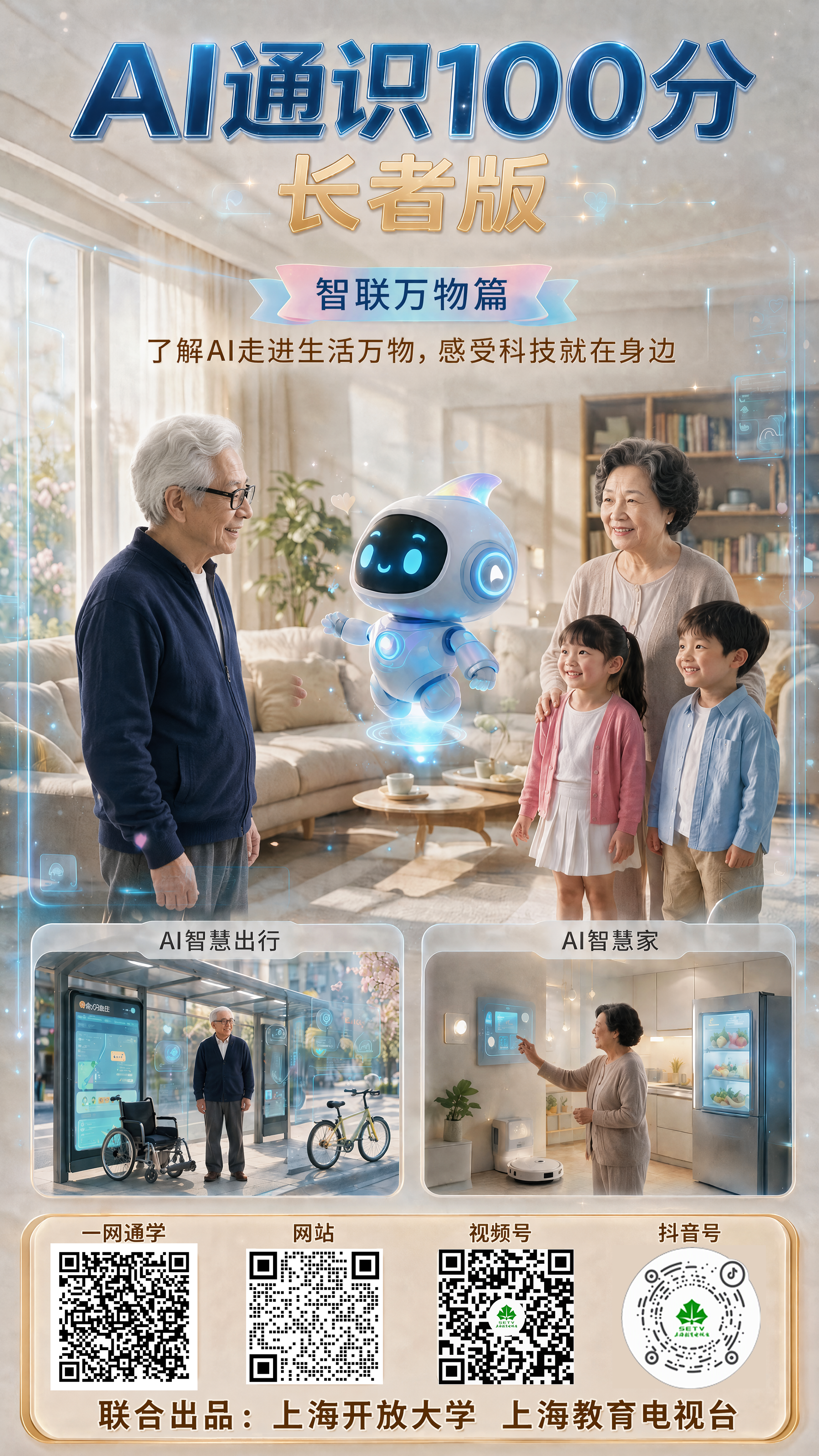
A tailor-made AI literacy course for older adults drew wide attention at the 2nd Shanghai Senior Learning Curriculum Exhibition held at the Shanghai Exhibition Centre. Starting November 2, AI 101 for Seniors, a 100-episode short video series jointly developed by Shanghai Open University and Shanghai Education TV Station, has officially premiered. Available both at the offline exhibition and across major online platforms, the series delivers systematic, barrier-free AI learning content for senior residents in Shanghai.
To align the curriculum with seniors’ learning perspectives and usage habits, a unique co-creation component featuring elderly participants was integrated into production. Learners from the AI Short Video Creation Class of Shanghai Open University joined the programme team as special contributors. More than mere learners and testers, these senior creators took deep part in the whole development process, contributing ideas for topics and fine-tuning scene details.
From Pain Points to Co-creation: A Custom-built Curriculum for Seniors
Many older adults find advanced technology intimidating. Rapid technological advances bring confusing interfaces, tricky operations and emerging AI-enabled scams, creating anxiety and a persistent digital divide. Bridging this gap and making AI accessible to seniors has become a key public concern.
AI 101 for Seniors was developed to address this need. It supports the national “AI+” initiative to expand public AI literacy and serves as a core output of the research project “Implementation Pathways and Models of AI Literacy Education for Seniors” led by Shanghai Open University. Built on solid research findings and powered by AIGC video generation, the series targets adults aged 55 to 75. Each five-minute episode demonstrates practical, real-life AI applications, translating academic research into accessible, everyday learning.
From Vision to Curriculum: A New Model of Age-friendly AI Education
Centered on the mission of “digital inclusion and life empowerment”, the course is systematically designed across five dimensions: knowledge building, motivation stimulation, skill development, role transformation and value enhancement. The 100 episodes fall into seven modules: AI basics, everyday tools, life scenarios, health and wellness, family connection, fraud prevention, and the internet of everything. Learners progress step by step: from understanding AI, to solving daily problems, managing family health, strengthening intergenerational bonds, safeguarding personal finances, and operating smart devices. The structured curriculum helps seniors build digital confidence and enjoy the convenience brought by technology.
Breaking the conventional senior education format, the series uses an AI virtual host and adopts scenario-based, narrative-driven storytelling. Lessons revolve around real-life challenges seniors encounter, turning abstract tech concepts into simple, actionable workflows. Story-led narration and a warm, conversational tone make AI far less daunting.
Every detail is refined for elderly viewers. Jargon is avoided, and each episode focuses on one practical problem. It follows a three-part structure: scenario introduction, step-by-step demonstration, and key takeaway recap. Guided by the AI robot host “Xiaozhi”, the five-minute bite-sized format matches seniors’ attention spans, lowering cognitive load and sustaining engagement. The visuals feature large fonts, high-contrast graphics, slow pacing and clear voiceover to suit older adults’ sight and hearing.
Fraud prevention stands as an independent module. With tutorials and illustrations, seniors learn to spot red flags of deepfake scams, including AI face swapping, voice cloning and fake customer service impersonation, embedding cybersecurity awareness throughout the learning journey.
The guiding principle for production is simple: easy to understand, easy to learn, easy to use. As an open educational resource, the series will keep updating alongside AI innovation. The bonus “Internet of Everything” chapter showcases age-friendly smart technology — smart home gadgets, health trackers and exoskeleton robots — revealing how connected technology can enrich later life.
Online and Offline: Building an Ecosystem of Senior Digital Education
To reach more older learners, AI 101 for Seniors rolls out across a multi-channel network: television broadcast, online platforms, social media and offline exhibitions. From November 2 to 4, the series was showcased with interactive experiences at the Shanghai Exhibition Center. On Shanghai Education TV, new episodes air on weekdays at 10:30, with reruns at 19:30, scheduled around seasonal topics and senior viewers’ interests. Episodes are also published on the station’s official website, WeChat channels, video accounts and Douyin, plus the Shanghai “One-Stop Learning” portal for on-demand viewing anytime.
New episodes of this high-quality 100-part series will continue to launch. Stay tuned.