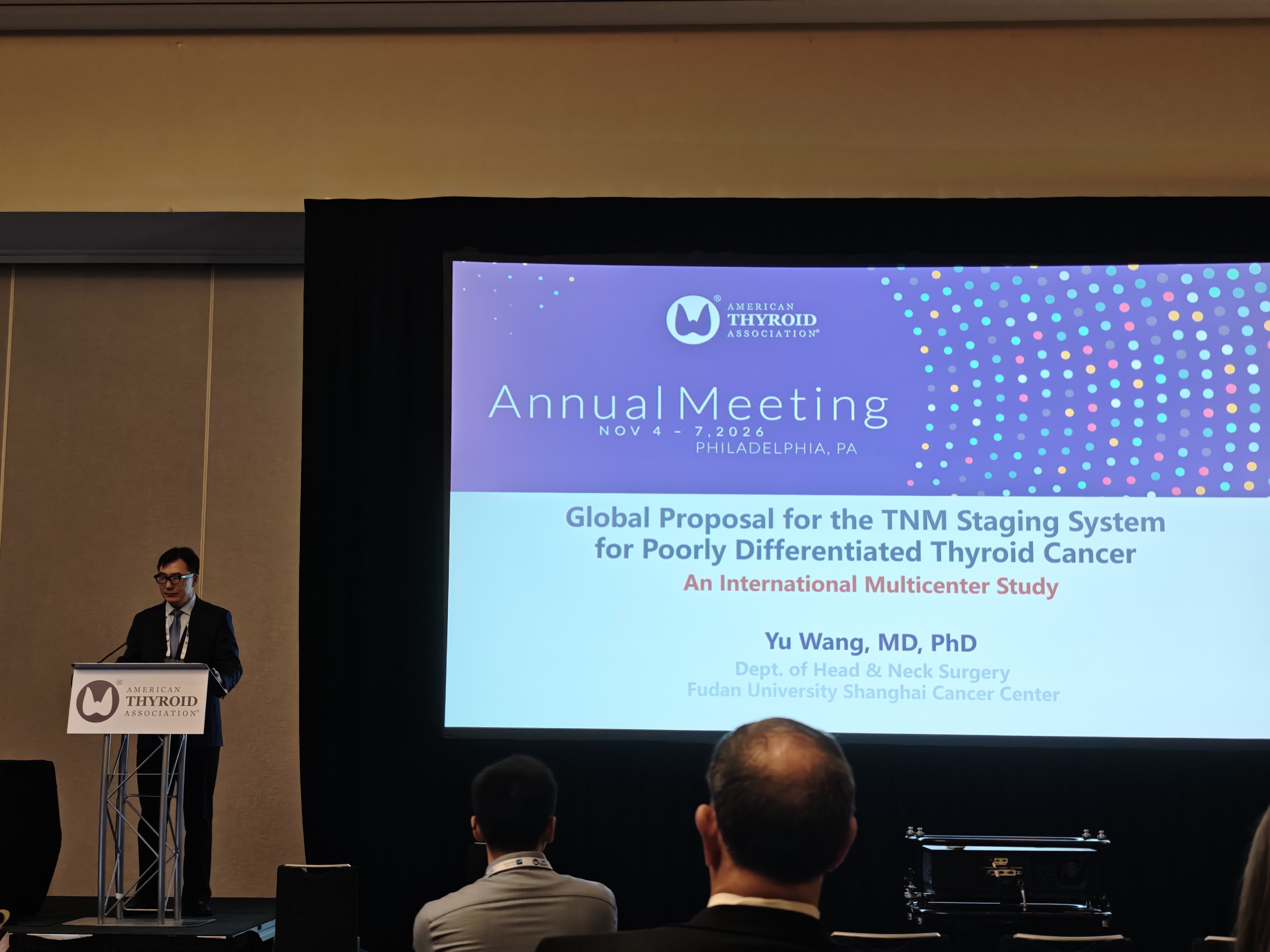
Two landmark global collaborative studies led by Professor Wang Yu from Fudan University Shanghai Cancer Center deliver brand-new tailored TNM staging frameworks for medullary thyroid carcinoma (MTC) and poorly differentiated thyroid carcinoma (PDTC). The findings were delivered as oral presentations at the 2026 American Thyroid Association (ATA) Annual Meeting and published simultaneously online in Journal of Clinical Oncology (JCO) and JAMA Oncology.
Medullary thyroid carcinoma (MTC) and poorly differentiated thyroid carcinoma (PDTC) are relatively rare but markedly more aggressive, carrying a substantially higher risk of disease-specific mortality. The TNM staging system jointly maintained by the American Joint Committee on Cancer (AJCC) and the Union for International Cancer Control (UICC) serves as the shared language of global oncology practice and research, providing prognostic stratification and informing postoperative surveillance, risk management and clinical trial stratification. Yet the current eighth edition falls short for both tumour types: nodal stratification for MTC does not fully align with real-world outcomes, concentrating too many patients in advanced stages, while PDTC has long lacked a dedicated staging framework and has had to borrow the differentiated thyroid carcinoma model, which does not reflect its distinct biology.
To address these long-standing gaps, the team established an international collaborative network spanning clinical centres across more than 10 countries on six continents. Pooling large global cohorts for MTC and PDTC respectively, the research team developed new international staging proposals better aligned with the biological behaviour and actual prognosis of both diseases.
MTC: Redefining Nodal Stratification, Correcting Stage Migration
For medullary thyroid carcinoma, the collaboration assembled 2,573 patients from 43 centers in 15 countries — the largest international multicentre MTC cohort to date — and independently validated the findings in 1,909 patients from the US SEER database. Analyses showed that patients with metastases to level VII (upper mediastinal) nodes had markedly poorer disease-specific survival. The team therefore reclassified this group from the former N1a category into a newly defined N1c category and rebuilt the stage groupings accordingly.
Compared with AJCC eighth edition, the new proposal delivers stronger prognostic discrimination, with disease-specific mortality risk escalating more clearly across stages. It also substantially alleviates the previous system's over-concentration in stage IV: in the international collaborative cohort, the proportion of stage IV patients fell from 42.4% to 20.2%. This shift does not imply reduced treatment intensity but rather brings staging closer to patients' true risk. On one hand, it avoids prematurely labelling some patients with favourable prognosis as "advanced," easing unnecessary psychological burden; on the other, it helps clinicians calibrate surveillance intensity, long-term follow-up and risk-stratified management more rationally. A commentary in JCO noted that these adjustments carry important implications for future TNM revisions and for postoperative follow-up and management of MTC.
PDTC: A Dedicated Framework Built on Its Own Biology
In the poorly differentiated thyroid carcinoma study, the International Aggressive Thyroid Cancer Collaboration enrolled 1,010 patients from 91 centers in 14 countries and externally validated results in 170 cases from the SEER database, establishing the largest global PDTC cohort. PDTC has long lacked a dedicated TNM system and has relied on differentiated thyroid carcinoma criteria. The research found that the 55-year age cutoff widely used in differentiated thyroid carcinoma does not effectively discriminate prognosis among PDTC patients with distant metastasis, so the new framework abandons that age rule. Level VII nodal involvement likewise conferred poorer survival and was similarly defined as N1c. On this basis, the team constructed a TNM system specific to PDTC.
Compared with borrowing differentiated thyroid carcinoma staging, the new PDTC proposal reclassifies more genuinely high-risk patients into advanced stages: the proportion of stage I patients fell from 44.4% to 24.6%, while stage IV rose from 18.5% to 32.4%. Overall survival risk now presents a clearer gradient across stages, model discrimination improved, and the scheme was validated in an external population. Its clinical value lies in treating PDTC not as an appendage of differentiated thyroid carcinoma but as a disease stratified by its own biology — providing a more reliable basis for prognostic communication, surveillance intensity design, clinical trial stratification and combination therapy research. The authors emphasise that TNM staging primarily reflects anatomical extent and prognostic risk; specific treatment decisions must still integrate resectability, molecular features, patient general status and multidisciplinary assessment.
Origins: Solving the Evidence Problem in Rare Tumours
The studies grew from a core clinical question for rare cancers: how to generate sufficiently high-level evidence. In 2025, Professor Wang was invited to join the AJCC Expert Panel on Endocrine Diseases, contributing to discussions on staging for thyroid and other endocrine tumours. There he put forward that for diseases such as MTC and PDTC — where cases are dispersed and single centres cannot accumulate adequate sample sizes — only cross-national, multi-institutional collaboration can generate representative and externally generalisable staging evidence. The proposal drew swift support from specialists worldwide, with participating institutions spanning North America, South America, Oceania, Asia, Europe and Africa, all high-volume thyroid tumour referral and research centres. The International Medullary Thyroid Carcinoma Staging Collaboration and the International Aggressive Thyroid Cancer Collaboration were subsequently founded.
After ethics review, data de-identification and standardisation at each participating centre, the team applied unified definitions, centralised quality control and statistical modelling to cases accrued across different countries, health systems and eras, refining the proposals through multiple rounds of international expert review. Such global coordination is especially critical for rare tumours: it not only overcomes the sample-size limitations of single institutions but also minimises bias arising from any one region's practice patterns, ensuring the new staging can withstand validation across diverse populations and care settings.
From Participation to Leadership in Global Standards
Together, the two studies address a persistent challenge: how to overcome the evidence constraints of single centres and build risk-stratification frameworks validated across countries and health systems for rare, heterogeneous and highly aggressive thyroid cancers. The output is not a "new standard" already formally adopted by AJCC, but an international staging proposal initiated by Fudan University Shanghai Cancer Center, led by a Chinese team and shaped through global multicentre participation — supplying large-scale, cross-population evidence for future revisions of the international staging system.
Professor Wang noted that the team will next conduct long-term validation and explore how molecular features and pathological subtyping can complement the anatomical TNM framework, advancing staging from describing disease extent toward enabling finer risk management and clinical research.
The dual oral presentations at the ATA Annual Meeting and simultaneous publication in two flagship clinical oncology journals carry significance beyond publication itself. They signal that Chinese thyroid oncology researchers are moving from participating in international multicentre studies toward proactively framing clinical questions, organising global collaboration and generating evidence that can inform international standard revisions. With deep involvement of internationally renowned and leading centres, the studies strengthen the representativeness and credibility of staging evidence for rare tumours, contributing China-led, globally collaborative evidence to future AJCC/UICC staging updates.